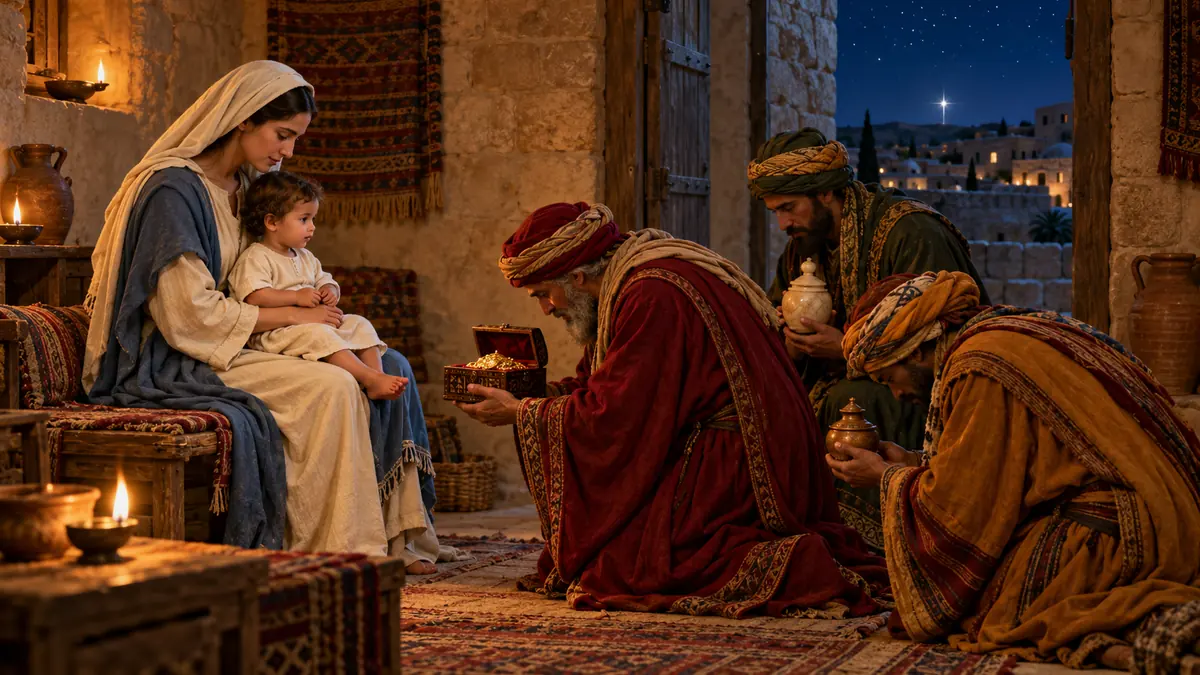
The three wise men are traditionally named Caspar (or Gaspar), Melchior and Balthazar, but those names come from church tradition, not from the Bible. Their visit is told only in Matthew 2:1-12, which calls them magi “from the east,” and Matthew never gives their names, their number or a royal title. He says they found the child in “the house” and never mentions a stable.
Here is what Matthew says next to where each popular detail came from.
| Detail | What Matthew 2 says | Where the popular picture came from |
|---|---|---|
| Names | None | Early Latin spellings, then Gaspar, Melchior and Balthasar from the 600s |
| Number | Not given | Three gifts suggested three givers; Eastern tradition often says twelve |
| Kings | Calls them magi, not kings | Christians reading Psalm 72 and Isaiah 60 alongside Matthew |
| Homeland | ”From the east” | Early writers named Persia, Babylon or Arabia |
| Place | ”The house” (2:11) | Nativity scenes merge Matthew’s visit with Luke’s manger |
| Timing | After the birth, no interval stated | Herod’s “two years old or under” (2:16) is the strongest clue |
| Afterward | Home “by another way” (2:12) | Later legends, relics in Cologne, tombs in Persia |
Start each morning in the Word
Get the free 7-day reading plan, then one short devotional each morning.
Where the names Caspar, Melchior and Balthazar come from
The oldest known list of names for them is in a chronicle called the Excerpta Latina Barbari, a rough Latin translation of a Greek chronicle. Its English translator at attalus.org dates the Greek original to about AD 500, and the Latin copy is usually dated to the 700s. Its entry for the visit reads: “The names of the Magi were Bithisarea, Melichior and Gathaspa.” The Catholic Encyclopedia’s entry on the magi finds the familiar Latin forms, Gaspar, Melchior and Balthasar, in use “from the seventh century.”
Other churches kept other names. The same entry lists Larvandad, Hormisdas and Gushnasaph among Syrian Christians, and Kagba and Badadilma among Armenians. None of these lists comes from Matthew, who names no one.
What Matthew actually says
Here is the whole account, Matthew 2:1-12 (ESV):
Now after Jesus was born in Bethlehem of Judea in the days of Herod the king, behold, wise men from the east came to Jerusalem, saying, “Where is he who has been born king of the Jews? For we saw his star when it rose and have come to worship him.” When Herod the king heard this, he was troubled, and all Jerusalem with him; and assembling all the chief priests and scribes of the people, he inquired of them where the Christ was to be born. They told him, “In Bethlehem of Judea, for so it is written by the prophet: ‘And you, O Bethlehem, in the land of Judah, are by no means least among the rulers of Judah; for from you shall come a ruler who will shepherd my people Israel.’” Then Herod summoned the wise men secretly and ascertained from them what time the star had appeared. And he sent them to Bethlehem, saying, “Go and search diligently for the child, and when you have found him, bring me word, that I too may come and worship him.” After listening to the king, they went on their way. And behold, the star that they had seen when it rose went before them until it came to rest over the place where the child was. When they saw the star, they rejoiced exceedingly with great joy. And going into the house, they saw the child with Mary his mother, and they fell down and worshiped him. Then, opening their treasures, they offered him gifts, gold and frankincense and myrrh. And being warned in a dream not to return to Herod, they departed to their own country by another way.
The visitors go to Jerusalem first and ask for the one “born king of the Jews.” Herod, the king already on the throne, is “troubled,” and his own scholars point to Bethlehem by quoting the prophet Micah (Micah 5:2). Matthew ties events to Old Testament lines like this all through his Gospel, starting with the Immanuel prophecy one chapter earlier. The only people in the passage called king are Herod and the child.
Who the magi were
The ESV’s footnote on 2:1 gives the Greek word behind “wise men”: magi. Abbott-Smith’s lexicon, quoted on Bible Hub’s entry for the word, describes a magos as “one of a sacred caste, originally Median, who seem to have conformed to the Persian religion.” The Catholic Encyclopedia says that religion was “fundamentally that of Zoroaster.”
The same Greek word can also mean a sorcerer. It appears six times in the New Testament: four times in Matthew 2 and twice in Acts 13, for the false prophet Bar-Jesus whom Paul met on Cyprus. Translations split it accordingly:
| Translation | Matthew 2:1 | Acts 13:6 |
|---|---|---|
| ESV | wise men | magician |
| KJV | wise men | sorcerer |
| NIV | Magi | sorcerer |
| NASB | magi | magician |
| NRSVUE | magi (footnote: “Or astrologers”) | magician |
| NLT | wise men (footnote: “Or royal astrologers”) | sorcerer |
Thayer’s lexicon on the same page puts the range plainly: the name was given to “wise men, teachers, priests, physicians, astrologers, seers, interpreters of dreams, augurs, soothsayers, sorcerers etc.” Some early writers read Matthew’s visitors toward the darker end. Origen described magi as “being on familiar terms with evil spirits” (Against Celsus 1.60), and Justin Martyr said they had been “held in bondage” by a demon before they came to worship (Dialogue with Trypho 78). The Catholic Encyclopedia counts Augustine and Jerome with them but calls that “not the common interpretation” and argues that Matthew meant priestly sages.
Where did the wise men come from?
Matthew says only “from the east.” The ESV footnote on 2:2 adds that “when it rose” can also be translated “in the east,” so even the star’s direction is open. Early writers disagreed about the homeland. Justin calls them “Magi who came from Arabia.” The Catholic Encyclopedia lists Clement of Alexandria and Cyril of Alexandria for Persia, and Maximus and Theodotus of Ancyra for Babylon. The word’s Persian roots point some readers to Persia, but the text doesn’t name a country.
Matthew also doesn’t explain the star. Proposals such as a comet or a lineup of planets go beyond what the passage says, and what the star of Bethlehem was sets the main views side by side. The wise men appear only in Matthew, one part of the Christmas story across Matthew and Luke.
How many wise men were there?
Matthew doesn’t say. The usual Western number, three, matches the three gifts, though John Calvin pointed out in his commentary on Matthew 2:1-6 that Matthew says the gifts were “presented by them in common,” not one gift per person.
The Catholic Encyclopedia says “in the Orient, tradition favours twelve.” Early Christian art didn’t agree either. It lists a painting in the cemetery of Saints Peter and Marcellinus showing two magi, one in the Lateran Museum showing three, one in the cemetery of Domitilla showing four, and a vase in Rome’s Kircher Museum showing eight. Three won out in the West, but the number stays open.
Were the wise men kings?
Not in Matthew. The royal picture grew from reading Matthew next to two Old Testament passages. Psalm 72, a prayer for Israel’s king, says, “may the kings of Sheba and Seba bring gifts! May all kings fall down before him” (Psalm 72:10-11). Isaiah 60 pictures “kings to the brightness of your rising” and says of those from Sheba, “They shall bring gold and frankincense” (Isaiah 60:3, 6).
Writing in the early 200s, Tertullian connected the gift of gold to Psalm 72 and said “the East generally regarded the magi as kings” (Against Marcion 3.13). The Catholic Encyclopedia renders his Latin, fere reges, as “wellnigh kings” and says plainly, “No Father of the Church holds the Magi to have been kings.” It notes that church liturgy applies Psalm 72 to the magi, but says that use doesn’t prove they were kings.
Calvin rejected the idea outright, arguing that Psalm 72 names lands to the west and south, while Matthew’s visitors came from the east. The link to Psalm 72 and Isaiah 60 is one Christian readers drew. Matthew doesn’t draw it himself.
When did the wise men visit Jesus?
After the birth, but Matthew never says how long after. Luke tells the birth story, with Mary laying the baby “in a manger, because there was no place for them in the inn” (Luke 2:7), and the visitors there are shepherds. Matthew’s magi find “the child” in “the house” (Matthew 2:11).
One clue comes after they leave. Herod killed the boys in Bethlehem “who were two years old or under, according to the time that he had ascertained from the wise men” (Matthew 2:16). That shows what Herod worked out from the magi’s answer, not a date for the visit.
Early Christians read the gap differently. Justin placed the visit at a cave near Bethlehem where the newborn lay in a manger. According to the Catholic Encyclopedia, Augustine reasoned from the feast days that the magi came thirteen days after the birth, and Epiphanius concluded from Herod’s order that they came two years later. The encyclopedia’s own writer argues for about a year. A nativity set with the magi at the manger combines Luke’s scene and Matthew’s into one.
Western churches came to tie the January 6 feast of Epiphany above all to the magi. The Catholic Encyclopedia’s entry on Epiphany says the West took up the Eastern January feast and, “as time went on,” gave “overwhelming importance” to the magi’s visit.
Gold, frankincense and myrrh
Matthew names the gifts and doesn’t explain them. Gold was wealth. Frankincense is a fragrant resin from Boswellia trees, and myrrh a fragrant gum resin from Commiphora trees, according to Bible Hub’s topical entries. Myrrh shows up again at the end of Jesus’s life, when Nicodemus came “bringing a mixture of myrrh and aloes” for his burial (John 19:39).
Origen, writing in the 200s, said the magi offered “gold, viz., as to a king; myrrh, as to one who was mortal; and incense, as to a God” (Against Celsus 1.60). John Henry Hopkins put the same reading into his 1857 carol “We Three Kings,” whose last verse calls Jesus “King and God and sacrifice” (Hymnary.org). The Catholic Encyclopedia takes a more cautious line: “The Magi probably meant no symbolism,” and “it is not clear that any of these meanings are inspired.” Matthew leaves the question open.
What happened to the wise men afterward
Matthew’s last word on them is that they “departed to their own country by another way” (Matthew 2:12). Everything after that comes from later sources. A story that the apostle Thomas baptized them traces to a writer “of not earlier than the sixth century” who drew on an apocryphal book, the Catholic Encyclopedia says. Cologne Cathedral in Germany holds what are claimed to be their remains, brought from Milan in the 1160s.
Marco Polo wrote that he saw three tombs of the magi at Saba in Persia, but the townspeople could tell him only that “these were three kings who were buried there in days of old” (The Travels of Marco Polo, book 1, chapter 13, Yule translation). None of these claims comes from the Gospel.
Questions people ask
Did the three wise men have names? Not in the Bible. Matthew never names them. The oldest known list, in a Latin chronicle translated from Greek, spells them Bithisarea, Melichior and Gathaspa; the Catholic Encyclopedia finds Gaspar, Melchior and Balthasar in Latin use from the seventh century. Syrian and Armenian Christians used different names.
What is the name of the Black wise man? In Western tradition, Balthazar. The J. Paul Getty Museum’s Balthazar exhibition notes that early medieval legends placed one of the three kings in Africa, but that it was “nearly one thousand years” before artists began painting Balthazar as a Black African. Matthew says nothing about how any of them looked.
What do gold, frankincense and myrrh symbolize? The best-known reading goes back to Origen in the 200s: gold for a king, incense for God and myrrh for a mortal man. It is an old interpretation, not something Matthew states.
Did the wise men meet Jesus? Yes. Matthew says they “saw the child with Mary his mother, and they fell down and worshiped him” (2:11). He places the meeting in a house and doesn’t give Jesus’s age, so how long after the birth it happened is still debated.
What happened to the wise men after they left Jesus? The Bible says only that they went home another way after a warning dream (2:12). Accounts of their later lives, baptism and burial are traditions from centuries afterward.
Read the story itself
Open your Bible to Matthew 2 and read the whole chapter. It’s twenty-three verses long. The wise men’s visit fills the first twelve, and the rest follows Joseph, Mary and the child to Egypt and back.
Scripture quotations are from the ESV unless another translation is named. Greek word definitions are from Abbott-Smith’s and Thayer’s lexicons as quoted on Bible Hub.