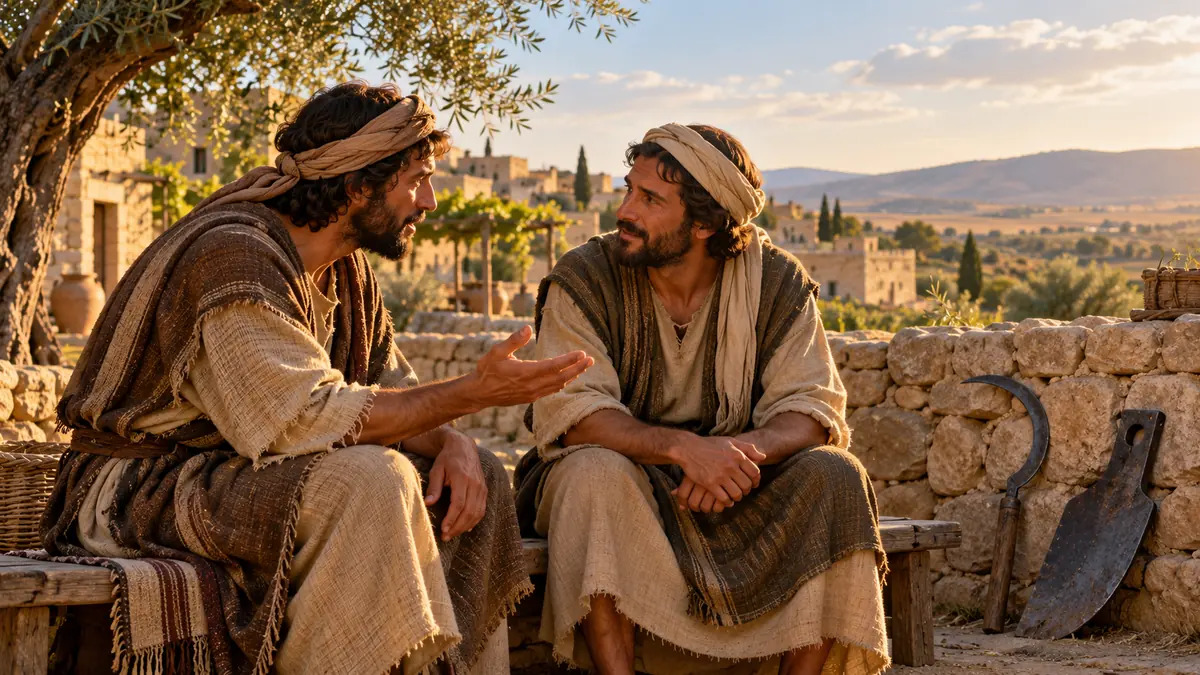
“Iron sharpens iron” means people make each other better the way one piece of iron puts an edge on another. The saying comes from Proverbs 27:17, and read with the verses around it, that sharpening includes honest counsel from a friend who stays. In the Hebrew, the friend sharpens your face.
“Iron sharpens iron, and one man sharpens another.” (Proverbs 27:17, ESV)
Today it turns up in church small groups and on fitness accounts alike. The ESV’s footnote on the verse gives the literal Hebrew: “sharpens the face of another.”
Start each morning in the Word
Get the free 7-day reading plan, then one short devotional each morning.
Where does “iron sharpens iron” come from?
Proverbs is mostly a collection of short, two-line sayings, and each one usually stands on its own. Chapter 25 opens a new section with a heading: “These also are proverbs of Solomon which the men of Hezekiah king of Judah copied” (Proverbs 25:1). Chapter 27 sits inside that section, so by the book’s own account, men serving a later king gathered these older sayings and copied them. That is part of the longer story of who wrote Proverbs. In the book as we have it, the saying sits among many others, and the lines around it in chapter 27 keep coming back to friends.
What the Hebrew says, and how translations differ
The Hebrew line is short and repeats itself. The Bible Hub interlinear shows the word for iron twice and the verb for sharpen twice, then “a man,” “the face,” and “his friend.” Both verbs are tagged to a root that the Brown-Driver-Briggs lexicon defines as “be sharp, keen.” English versions handle the second half of the verse in several ways (Bible Gateway, all English versions):
| Version | Second half of Proverbs 27:17 |
|---|---|
| KJV | ”so a man sharpeneth the countenance of his friend” |
| Young’s Literal | ”And a man sharpens the face of his friend” |
| NRSVue | ”and one person sharpens the wits of another” (footnote: Hebrew “face”) |
| ESV | ”and one man sharpens another” (footnote: Hebrew “sharpens the face of another”) |
| NIV, NASB, CSB | ”one person sharpens another” (CSB footnote: literally “his friend’s face”) |
| NET | ”so a person sharpens his friend” |
| NLT | ”so a friend sharpens a friend” |
“Countenance” is an older English word for face. The split between “one man” and “one person” comes from the Hebrew word for “a man,” and the NET Bible’s translator note says the context “does not indicate this should be limited to males only.” For more on why versions choose differently, see NIV vs ESV vs KJV.
Why the face? The same NET note says the word “face” puts the emphasis on “the personality or character that is being sharpened.” Ellicott’s Commentary for English Readers puts it this way: “the play of wit with wit sharpens and brightens up the face.” Joseph Benson’s commentary reads the countenance as the mind or spirit, whose state is “commonly visible in men’s countenances.” Two verses later, the chapter uses the same Hebrew word for face, twice: “As in water face reflects face, so the heart of man reflects the man” (Proverbs 27:19).
The verses around it are about honest friends
The run of sayings before verse 17 makes the meaning clearer. “Better is open rebuke than hidden love” (Proverbs 27:5). “Faithful are the wounds of a friend; profuse are the kisses of an enemy” (27:6). A friend’s sweetness, verse 9 says, “comes from his earnest counsel.” And verse 10 says, “Do not forsake your friend and your father’s friend.”
Put those next to verse 17 and the picture is less about pep talks and more about truth from someone who stays. Verse 17 doesn’t name the friend’s motive, but read alongside verses 5 to 10, the sharpening can sting and comes from a faithful friend. Matthew Henry’s concise commentary reads verse 17 as a caution to “take heed whom we converse with,” and a charge “to make one another wiser and better.”
Is it a compliment or a warning?
Not every reader has taken the verse as praise for friendship. The Pulpit Commentary notes that some read it “in a bad sense, as if it meant that one angry word leads to another,” and it names Aben Ezra as one of them. That is Abraham ibn Ezra, the Spanish Jewish scholar who died in 1167. John Gill reports the same reading: “a wrathful man irritates and provokes wrath in another.”
The Pulpit Commentary adds that the Septuagint, the ancient Greek translation, “perhaps supports” that reading. Its verb for the second “sharpens” is paroxynei, which Thayer’s Greek lexicon says can mean “to stimulate, spur on” or “to irritate, provoke.” The related noun carries both senses in the New Testament: “stir up one another to love” in Hebrews 10:24 and the “sharp disagreement” between Paul and Barnabas in Acts 15:39 (Thayer). So the Greek word itself leaves both readings open.
The Pulpit Commentary itself takes the positive reading, saying “the best commentators” understand that time with other people shapes a person’s manner, character, and wits. Gill names two Jewish commentators, Jarchi and Gersom, who applied it to sharpening minds in learning. The Talmud reads it in that positive way too: Rabbi Hama son of Rabbi Hanina said that as one iron sharpens another, two Torah scholars sharpen one another in halakha, Jewish law (Ta’anit 7a, Sefaria). Both readings agree that people rub off on each other. Proverbs 13:20 says so plainly: “Whoever walks with the wise becomes wise, but the companion of fools will suffer harm.”
Does iron really sharpen iron?
The verse doesn’t explain how one piece of iron puts an edge on another. The Pulpit Commentary suggests a file was meant and points to 1 Samuel 13:21. Benson says iron tools were sharpened “by rubbing them against the file, or some other iron.”
That passage in 1 Samuel shows sharpening as paid work. In Saul’s day there was “no blacksmith to be found throughout all the land of Israel,” so “every one of the Israelites went down to the Philistines to sharpen his plowshare, his mattock, his axe, or his sickle,” and paid a set charge (1 Samuel 13:19-21). The ESV notes that the meaning of the Hebrew in verse 21 is uncertain. Past that, the Bible gives no metalworking detail, so it is best not to build lessons on it.
Examples of iron sharpening iron in the Bible
Proverbs 27:17 doesn’t name examples, but a few scenes elsewhere show the same kinds of honesty that chapter 27 describes. These are comparisons, not passages the proverb points to.
- Encouragement: when Saul was hunting David, Jonathan “went to David at Horesh, and strengthened his hand in God” (1 Samuel 23:16).
- Rebuke: after David’s sin with Bathsheba, the prophet Nathan told him, “You are the man!” (2 Samuel 12:7).
- Disagreement: Paul writes that when Cephas (Peter) came to Antioch, “I opposed him to his face” (Galatians 2:11).
What it looks like now
The plain sense of Proverbs 27:17 is that you are shaped by the people you spend time with, and you shape them back. Read with verses 5, 6, and 9, the kind of sharpening the chapter values is honest counsel from a friend who is still there afterward.
Ecclesiastes 4:9-10 (“Two are better than one”) and Hebrews 10:24-25 carry the same idea.
What the verse doesn’t do is license harshness. The wounds Proverbs calls faithful come from a friend, and bluntness from someone with no relationship doesn’t fit that picture.
If you’ve only known the phrase as a slogan, open your Bible to Proverbs 27 and read verses 1 through 19 in one sitting. Verse 17 reads differently in its own neighborhood. For another everyday phrase with a Bible origin, see by the skin of your teeth.
Questions people ask
Where is “iron sharpens iron” in the Bible?
Proverbs 27:17. The ESV reads, “Iron sharpens iron, and one man sharpens another.” It sits in the section of Proverbs that Hezekiah’s men copied (Proverbs 25:1).
Does “one man sharpens another” mean the verse is only about men?
The Hebrew uses the word for “a man,” which the ESV keeps. The NIV, NASB, CSB, and NRSVue say “one person,” and the NET’s translator note says the context does not limit it to males.
What does iron stand for in this verse?
Most likely ordinary tools. The verse doesn’t say, but Benson and the Pulpit Commentary both read it as the iron of working tools, like the plowshares and axes in 1 Samuel 13:20. Elsewhere the Bible uses iron as a picture of strength and force, as in a kingdom “strong as iron” (Daniel 2:40).
What is the deeper meaning of Proverbs 27:17?
Read in its chapter, it describes friends who improve each other through honest words, the “faithful” wounds of 27:6 and the “earnest counsel” of 27:9. The NET’s translator note says the Hebrew “face” puts the stress on character.