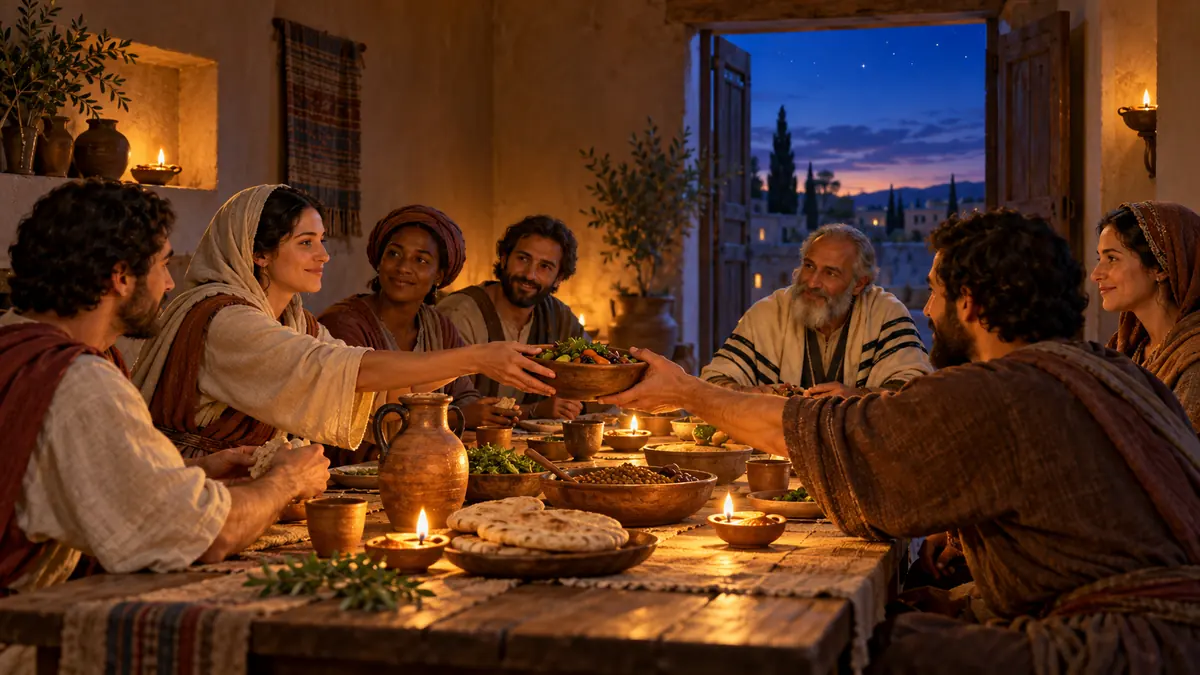
“May the God of hope fill you with all joy and peace in believing, so that by the power of the Holy Spirit you may abound in hope” (Romans 15:13, ESV).
In plain words: Paul prays that God, the giver of hope, will fill the believers in Rome with joy and peace as they trust him, so that the Holy Spirit makes their hope overflow. The verse is a prayer, not a command. It closes a chapter and a half in which Paul has been correcting a church divided over food and holy days.
Start each morning in the Word
Get the free 7-day reading plan, then one short devotional each morning.
The church Paul prayed for was arguing about food
The believers in Rome disagreed about what to eat and which days to keep. “One person believes he may eat anything, while the weak person eats only vegetables,” Paul writes, and “one person esteems one day as better than another, while another esteems all days alike” (Romans 14:2, 5). He tells each side not to despise or judge the other (Romans 14:3). His summary in Romans 14:17 is blunt: “the kingdom of God is not a matter of eating and drinking but of righteousness and peace and joy in the Holy Spirit.”
Chapter 15 keeps going. The strong “have an obligation to bear with the failings of the weak, and not to please ourselves” (Romans 15:1). Paul wants them “with one voice” to glorify God (Romans 15:6), and he tells them, “welcome one another as Christ has welcomed you” (Romans 15:7). He then says Christ served “the circumcised” so “that the Gentiles might glorify God for his mercy” (Romans 15:8-9), and he backs it with four Old Testament quotations about Gentiles praising God, from the Psalms, Deuteronomy and Isaiah (Romans 15:9-12). The last one ends: “in him will the Gentiles hope.”
Verse 13 comes next, and it is a prayer rather than another argument. Older commentators noticed the turn. The Cambridge Bible says Paul “takes up the last word of the last quotation” and “ceases now to speak of controversy” (Cambridge Bible on Romans 15). Alexander Maclaren calls it the close of Paul’s “exhortation to the factions in the Roman Church to be at unity” (MacLaren’s Expositions). On a greeting card the line reads like a general blessing. Read inside its own chapter, it is a prayer for people Paul has just been correcting. Praying for other people this way is what Christians call intercessory prayer.
What each part of the verse says
“May the God of hope”
“May” marks the verse as a prayer. Bible Hub’s interlinear for Romans 15:13 tags the Greek verb for “fill” (plērōsai) as optative, the form Greek uses for wishes and prayers. Paul prays the same way at Romans 15:5 (“May the God of endurance and encouragement grant you…”) and again at 15:33 (“May the God of peace be with you all”).
“God of hope” picks up the word Paul has just quoted. In Greek, verse 12 ends with “will hope” (elpiousin) and verse 13 opens with “the God of hope” (tēs elpidos), the same word family. Paul’s quotation follows the Septuagint, the ancient Greek translation of Isaiah, which Brenton’s English renders “in him shall the Gentiles trust” (Isaiah 11:10, Septuagint). The Hebrew text reads differently. Its verb is darash, “will seek” in Bible Hub’s Hebrew interlinear for Isaiah 11:10, which the ESV renders “of him shall the nations inquire.”
“Of hope” could mean the God people hope in, or the God who gives hope. Thayer’s Greek lexicon lists this verse as “God, the author of hope” (Strong’s 1680, elpis), and Albert Barnes reads it as the God who “inspires,” or “produces” Christian hope (Barnes’ Notes). The NLT translates it that way: “God, the source of hope.” The same Thayer entry defines the word, in its Christian sense, as “joyful and confident expectation of eternal salvation,” and Romans 15:13 is one of the verses it cites.
“fill you with all joy and peace in believing”
Joy and peace are two of the three words Paul used in Romans 14:17 for what God’s kingdom consists of. Matthew Poole links the two verses: “instead of those contentions that had been amongst them, he desires they may be filled with those things, wherein he told them, Romans 14:17, the kingdom of God consisted” (Poole’s Commentary).
“In believing” names where the filling happens. Barnes puts it simply: “The effect of believing is to produce this joy and peace.” Translations make the phrase either ongoing (“as you trust in him,” NIV) or causal (“because you trust in him,” NLT). Either way, no one has to produce the joy first to qualify. In the verse, God is the one who fills, and he fills people who are trusting him.
“so that by the power of the Holy Spirit you may abound in hope”
“Abound” translates a Greek verb that Thayer glosses “to abound, overflow” (Strong’s 4052). The power behind it is the Spirit’s. The verse never tells the reader to work up hope. It asks God to supply it.
Paul made a similar point earlier in the letter: suffering produces endurance, endurance produces character, character produces hope, and “hope does not put us to shame, because God’s love has been poured into our hearts through the Holy Spirit who has been given to us” (Romans 5:3-5). The Cambridge Bible points readers to Romans 5:1-5 for this whole verse. Paul ties joy and hope together again in Romans 12:12, “Rejoice in hope,” which the site’s devotional on that verse takes up.
Romans 15:13 in the ESV, NIV, KJV and other translations
| Translation | Wording |
|---|---|
| ESV | ”May the God of hope fill you with all joy and peace in believing, so that by the power of the Holy Spirit you may abound in hope.” |
| NIV | ”May the God of hope fill you with all joy and peace as you trust in him, so that you may overflow with hope by the power of the Holy Spirit.” |
| NLT | ”I pray that God, the source of hope, will fill you completely with joy and peace because you trust in him. Then you will overflow with confident hope through the power of the Holy Spirit.” |
| NASB | ”Now may the God of hope fill you with all joy and peace in believing, so that you will abound in hope by the power of the Holy Spirit.” |
| NKJV | ”Now may the God of hope fill you with all joy and peace in believing, that you may abound in hope by the power of the Holy Spirit.” |
| KJV | ”Now the God of hope fill you with all joy and peace in believing, that ye may abound in hope, through the power of the Holy Ghost.” |
None of these changes the core meaning. “In believing” stays close to the Greek, while “as you trust in him” says who the trust is in. “Abound” is older English, so the NIV and NLT say “overflow.” The KJV’s “Holy Ghost” is the older English name for the Holy Spirit; the Greek words are the same. The NLT spells out the prayer (“I pray that”), which most versions carry in the word “may” and the KJV in “Now the God of hope fill you.” You can compare the ESV, NIV and KJV side by side at Bible Gateway, and the site’s NIV, ESV and KJV comparison explains why versions differ in general.
Is Romans 15:13 a promise?
In form, it’s a prayer: Paul asking God for something on behalf of others. Older commentators describe what kind of prayer it is in different ways. The Geneva Bible notes say Paul “seals up as it were all the former treatise with prayers, wishing all that to be given them by the Lord, that he had commanded them” (Bible Hub, Romans 15:13 commentaries). Maclaren goes further and sees in it “the wish, which is also a promise.”
Both readings agree on where the hope comes from. Paul is asking for what the letter has already said God gives through his Spirit (Romans 5:5). What the verse does not give is a timetable. A prayer for joy is not a guarantee that a person will feel joyful by Thursday.
When you trust God but don’t feel the joy
If joy comes “in believing,” and you believe, where is it?
Look at who Paul was praying for. They were believers in the middle of a church dispute, and he wasn’t in an easy spot himself. He had often meant to visit Rome and “thus far” been prevented (Romans 1:13). He was about to carry aid to the saints in Jerusalem (Romans 15:25-26), and he asked the Romans to pray that he would be “delivered from the unbelievers in Judea” (Romans 15:31). Paul doesn’t tell the church to try harder at joy. He asks God to give it. A reader can do the same: pray this verse for yourself, or for someone else, the way Paul prayed it for Rome.
The setting also points somewhere practical. In this chapter, hope belongs to a whole church, and Paul sets it right beside the call for the strong to bear with the weak and for everyone to welcome one another.
Questions people ask
What does Romans 15:13 say in the KJV?
The KJV reads: “Now the God of hope fill you with all joy and peace in believing, that ye may abound in hope, through the power of the Holy Ghost.” “Holy Ghost” is the older English name for the Holy Spirit.
What does “the God of hope” mean in Romans 15:13?
It names God as the giver of hope. Thayer’s Greek lexicon lists Romans 15:13 under “God, the author of hope,” and the NLT translates the phrase “God, the source of hope.”
What does “abound in hope” mean?
To abound is to overflow, to have more than enough. In Romans 15:13 the overflow comes “by the power of the Holy Spirit,” so the hope is something God supplies, not something the reader manufactures.
Who was Romans 15:13 written to?
Paul wrote it to the believers in Rome (“To all those in Rome who are loved by God,” Romans 1:7). The chapters just before it, Romans 14:1 to 15:12, deal with a dispute among them over food and holy days.
Read the whole argument once
The best next step is to read Romans 14:1 through 15:13 in one sitting. By the time you reach the last verse, you’ll hear Paul take the last word of Isaiah’s line, “hope,” and turn it into a prayer for people who were still learning to welcome each other. The Restores My Soul devotional on Romans 15:13 is a short reading to go with it.