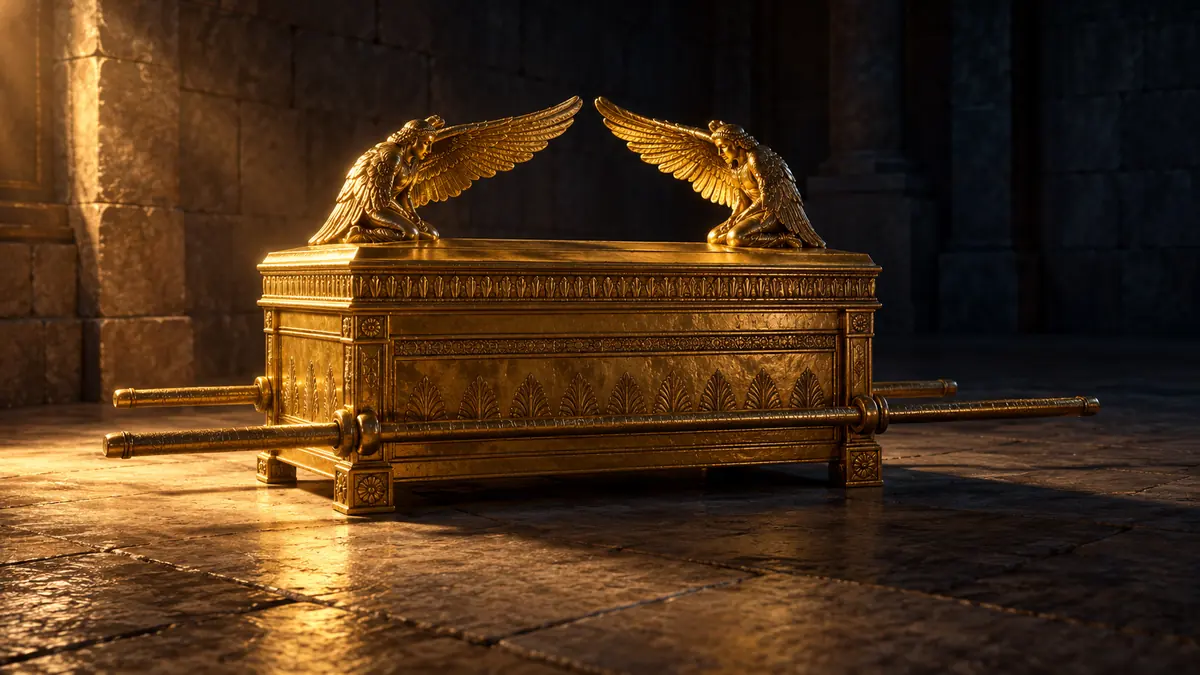
No one can show that the Ark of the Covenant still exists, and the Bible’s history of Israel’s kings never says what happened to it. That story last mentions it under King Josiah (2 Chronicles 35:3), and the lists of what Babylon took from the Temple never name it. The book of 2 Maccabees, which Catholic Bibles count as Scripture and Protestant confessions such as the Westminster Confession do not, says the prophet Jeremiah hid it in a cave. Claims that it sits in Ethiopia, under Jerusalem, in a cave or in heaven each rest on a different text, and none has been verified.
Start each morning in the Word
Get the free 7-day reading plan, then one short devotional each morning.
It was a gold-covered chest built as a meeting place
God tells Moses, “They shall make an ark of acacia wood” (Exodus 25:10, ESV), two and a half cubits long and a cubit and a half wide and high. The ESV footnote puts a cubit at about 18 inches, so by that figure the chest was about 45 by 27 by 27 inches. It was overlaid with pure gold, and its carrying poles “shall remain in the rings of the ark” (Exodus 25:11; 25:15).
The lid was the mercy seat (the ESV footnote gives “cover” as another rendering), with two gold cherubim of hammered work at its ends (Exodus 25:17-20). It was built for a meeting: “There I will meet with you” (Exodus 25:22). On the Day of Atonement, “once in the year,” the high priest sprinkled blood on the front of the mercy seat (Leviticus 16:14; 16:34). Priests later set it in the Most Holy Place, or Holy of Holies, of Solomon’s Temple (1 Kings 8:6).
English uses “ark” for two Hebrew words. Brown-Driver-Briggs (BDB) lists ‘aron as “chest, ark,” the word for the covenant ark, Joseph’s coffin (Genesis 50:26) and a Temple money chest (2 Kings 12:9). BDB lists tevah as “ark (properly chest, box),” used for Noah’s ark and the basket of baby Moses (Exodus 2:3). Thayer’s Greek lexicon notes that the Septuagint, the ancient Greek Old Testament, uses kibotos for both.
Hebrews and 1 Kings give different contents
The Bible gives two answers. At the Temple’s dedication, 1 Kings 8:9 names only the two stone tablets; Hebrews 9:4 also names a jar of manna and Aaron’s staff.
Hebrews 9:4, in a letter that never names its author, says the ark held “a golden urn holding the manna, and Aaron’s staff that budded, and the tablets of the covenant.” But 1 Kings 8:9, at the Temple’s dedication, says “There was nothing in the ark except the two tablets of stone that Moses put there at Horeb” (also 2 Chronicles 5:10).
Exodus 16:34 and Numbers 17:10 place the manna and Aaron’s staff “before the testimony,” and Deuteronomy 31:26 puts the Book of the Law “by the side of the ark.” Commentators explain the gap differently. Jamieson-Fausset-Brown says the items were “not in, but by it,” while Albert Barnes suggests Solomon “removed the pot of manna and the rod from the interior.” The Cambridge Bible thinks they rode inside while the ark traveled and came out at the Temple. All three commentaries come from Protestant scholars, so these are different explanations inside one tradition, not rival traditions.
In Jewish tradition, the Talmud (Bava Batra 14b) says the broken pieces of the first tablets were placed in the ark along with the second set, and Rabbi Meir held that a Torah scroll was too.
The Old Testament story last mentions the ark under Josiah
In his eighteenth year as king (2 Chronicles 35:19), Josiah tells the Levites, “Put the holy ark in the house that Solomon the son of David, king of Israel, built. You need not carry it on your shoulders” (2 Chronicles 35:3).
That order is read two ways. The Talmud (Yoma 52b) says Josiah buried the ark, reasoning from Deuteronomy 28:36 that it “should not be disgraced in exile.” Keil and Delitzsch reject the hiding reading because it “in no way corresponds to the words used,” and report that “most ancient and modern commentators” think the ark had been removed earlier and that Josiah was calling the Levites “to bring it back again to its place.”
Jeremiah 3:16 does not say where the ark went: “It shall not come to mind or be remembered or missed; it shall not be made again.” Keil and Delitzsch say it won’t be missed “because Jerusalem will then be the throne of the Lord.” The Cambridge Bible says it will be forgotten “because the whole city shall be filled with His presence.”
Babylon’s lists of what it took never name the ark
Britannica’s entry on the ark dates Babylon’s destruction of the Temple to 587 or 586 BC, the same fall that the book of Lamentations mourns (Lamentations 3:22-23 comes from it). Four passages list what Babylon took or destroyed: gold vessels cut in pieces (2 Kings 24:13); bronze pillars, the bronze sea and temple utensils after “he burned the house of the Lord” (2 Kings 25:9-17); the same list in more detail (Jeremiah 52:17-23); and the vessels of the house of God, “great and small” (2 Chronicles 36:18). The ark appears in none of them.
That silence proves nothing either way. The apocryphal book 1 Esdras can’t settle it: 1:54 reads “with the vessels of the ark of God” in the KJV but “the treasure chests of the Lord” in the RSV (1:51 in the NRSVue), and the Greek word there, kibotos, is plural.
Britannica’s summary: “Most historians think that if it existed, the more than 3,000-year-old relic either disintegrated over time or was destroyed. But this, too, is only speculation.”
Each theory about where it went rests on a different text
| Theory | Where it comes from | What that text says | Who holds it |
|---|---|---|---|
| Destroyed or carried off in the Babylonian sack | 2 Kings 25:9-17; 2 Chronicles 36:18-19 | The Temple burns and its vessels are listed; the ark is never named | Britannica’s summary of historians; Matthew Henry (“it is probable, the ark in it”) |
| Taken to Babylon | Talmud, Yoma 53b (William Davidson translation) | “the precious vessels of the house of the Lord” (2 Chronicles 36:10); “Nothing shall be left” (Isaiah 39:6) | Rabbi Eliezer and Rabbi Shimon ben Yoḥai (Yoma 53b) |
| Hidden by Josiah under the Temple | Yoma 52b; Mishnah Shekalim 6:1-2; Maimonides | ”Josiah, king of Judea, buried it”; a priest spotted an odd flagstone and died before he finished telling it | The teaching in Yoma 52b; Rabbi Yehuda ben Lakish (Yoma 53b: “buried in its place”); Maimonides |
| Hidden by Jeremiah in a cave | 2 Maccabees 2:4-8 (NRSVue) | Jeremiah “brought there the tent and the ark and the altar of incense; then he sealed up the entrance,” on “the mountain where Moses had gone up” | The writer of 2 Maccabees, citing an earlier document |
| Carried off by Shishak of Egypt | 1 Kings 14:25-26 | ”He took away everything,” but the ark isn’t named, and 2 Chronicles 35:3 mentions it long afterward | The premise of Raiders of the Lost Ark; the Associates for Biblical Research (Gary Byers, 2008) says it “is not a popular view today” |
| In Aksum, Ethiopia | The Kebra Nagast | Menelik, son of Solomon and the Queen of Sheba, brought it from Jerusalem (Britannica’s summary) | The Ethiopian Orthodox Tewahedo Church; only one guardian may see it |
| In heaven | Revelation 11:19 | ”the ark of his covenant was seen within his temple,” in a vision | Pulpit Commentary and Matthew Henry read it as a sign of God’s presence; the verse doesn’t say the ark itself is there now |
| Found in modern times | Claimants’ reports | No verified find | Ron Wyatt’s claim; Wyatt Archaeological Research says it “can provide no conclusive evidence” |
The Talmud records both rabbinic views side by side: some sages said the ark went to Babylon, others that it was hidden in its place (Yoma 53b). Mishnah Yoma 5:2 says that after the ark was taken, a rock called the foundation rock stood in the Holy of Holies, and the Gemara notes the wording is “taken,” not “buried.”
Second Maccabees raises a canon question. Catholic Bibles print the book (the USCCB’s NABRE does), the Westminster Confession calls the Apocrypha “no part of the canon,” and the Church of England’s Article VI reads them “for example of life” but not to establish doctrine. The mountain is usually taken to be Mount Nebo, where Moses climbed in Deuteronomy 34:1.
The Ethiopian church says the ark is kept at the Church of St. Mary of Zion in Aksum; each of its churches holds a tabot, a sacred replica. Britannica says the guardianship has made the claim “unverifiable,” and Smithsonian magazine (Raffaele, 2007) quotes Patriarch Abune Paulos saying he is “still forbidden from seeing it.” The Kebra Nagast’s date is disputed too. Britannica calls it a 14th-century epic, and Smithsonian reports that historians including Richard Pankhurst date the manuscript to the 14th century; the Ethiopian faithful, the same article says, hold that it was copied from a fourth-century Coptic manuscript.
Even the ark’s carriers were forbidden to look at it
Aaron and his sons cover the ark with the veil before the camp moves (Numbers 4:5). The sons of Kohath carry the covered items but “must not touch the holy things, lest they die” (Numbers 4:15), and “they shall not go in to look on the holy things even for a moment, lest they die” (Numbers 4:20).
First Samuel 6:19 records a deadly look at the ark. After the Philistines captured the ark (1 Samuel 4:11) and sent it back, the men of Beth-shemesh were struck “because they looked upon the ark of the Lord. He struck seventy men of them” (1 Samuel 6:19). The KJV and NIV say “looked into” instead (NIV, ESV and KJV compared). The KJV also counts 50,070, a number the ESV footnote traces to most Hebrew manuscripts.
When David moved the ark and the oxen stumbled, Uzzah “put out his hand to the ark of God and took hold of it,” and God “struck him down there because of his error” (2 Samuel 6:6-7). David afterward said “that no one but the Levites may carry the ark of God” (1 Chronicles 15:2).
The Bible leaves its end untold
Jeremiah 3:16 says the ark will not be missed. Second Maccabees 2:7 (NRSVue) says “The place shall remain unknown until God gathers his people together again and shows his mercy.” Neither tells you where it is.
In Numbers 7:89, Moses “heard the voice speaking to him from above the mercy seat.” Aaron and his sons, the priests who covered the ark, were also the ones told to bless Israel (Numbers 6:23); the site has a short devotional on that blessing in Numbers 6:24-26.
Questions people ask
Where is the Ark of the Covenant now? No one has shown where it is, or that it still exists. The Old Testament story last mentions it under King Josiah (2 Chronicles 35:3), and 2 Kings 25:9-17 never lists it among Babylon’s spoil. The Ethiopian church says it is in Aksum, where only one guardian may see it.
When was the Ark of the Covenant last seen? The Bible doesn’t record a last sighting. Its last narrative mention is Josiah’s order to the Levites in 2 Chronicles 35:3, in his eighteenth year as king. After that, Revelation 11:19 says “the ark of his covenant was seen” in God’s temple in heaven, but that is part of a vision, not a report of the object on earth.
Why can’t you look at the Ark of the Covenant? Numbers 4:20 told the sons of Kohath not to look on the holy things, even for a moment, “lest they die.” In 1 Samuel 6:19 the men of Beth-shemesh were struck for looking upon the ark, and the Ethiopian church lets only one guardian see the ark it claims.
How much would the Ark of the Covenant be worth? No honest estimate exists. Exodus 25 lists the size and materials, acacia wood and pure gold, but no weight. Aish quotes Rabbi Aryeh Kaplan: a solid gold cover would weigh “some 2500 pounds,” while other sources put it at one talent, about 150 pounds. Even the amount of gold is unknown.
Is there any proof the Ark of the Covenant existed? The evidence is written, not physical: the Bible’s books describe the ark, and later Jewish texts debate its fate. Britannica’s summary of historians begins “if it existed.” The ark claimed today in Aksum may be seen only by its guardian, and Wyatt Archaeological Research says it “can provide no conclusive evidence regarding the discovery of the Ark of the Covenant.”
Is the Ark of the Covenant in heaven? Revelation 11:19 says “the ark of his covenant was seen within his temple” in heaven, in a vision. Pulpit Commentary says the image spoke to readers who thought of the ark “as the sacrament of God’s abiding presence,” and Matthew Henry calls the ark “a token of the presence of God.” The verse says it was seen, not whether or how the ark got there.